
Introduction
Climate change is no longer a distant idea. It is a real challenge that affects weather, food, health, and economies around the world. As industries grow and energy use increases, carbon emissions continue to rise. This is where Carbon Capture & Climate Tech comes into focus as a practical solution. It offers tools and systems designed to reduce the amount of carbon dioxide released into the air.
Carbon Capture & Climate Tech is not about stopping progress. Instead, it helps balance development with environmental responsibility. Many governments, companies, and researchers now see it as a key part of climate action plans. From power plants to factories, these technologies aim to capture harmful gases before they reach the atmosphere.
What is Carbon Capture & Climate Tech?
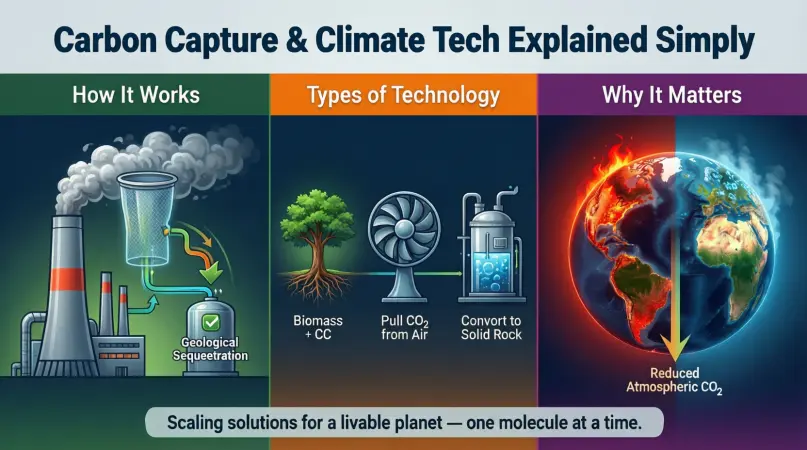
Carbon Capture & Climate Tech refers to a group of technologies designed to reduce carbon dioxide emissions from industrial and energy-related sources. These systems capture carbon before it enters the atmosphere and then store it underground or reuse it in other processes.
At its core, carbon capture focuses on prevention. Instead of allowing carbon dioxide to escape into the air, it is separated, compressed, and transported to a safe location. Climate tech expands this idea by including digital tools, clean energy systems, and smart monitoring methods that support emission reduction.
For example, a power plant can use carbon capture equipment to trap carbon from smoke stacks. That captured carbon can then be stored deep underground or used to make products like building materials or fuels. This makes Carbon Capture & Climate Tech both a protective and innovative solution.
Why is Carbon Capture & Climate Tech Important?
Carbon emissions are one of the main causes of global warming. Reducing them quickly is essential to limit environmental damage. Carbon Capture & Climate Tech plays an important role because it addresses emissions that are hard to eliminate through renewable energy alone.
Some industries, such as cement and steel, produce carbon as part of their core process. Even with clean energy, emissions would still occur. Carbon capture offers a way to manage this problem without shutting down critical industries.
Additionally, this technology supports climate targets set by many countries. It helps bridge the gap between current systems and a low carbon future. By combining innovation with responsibility, Carbon Capture & Climate Tech provides a realistic path toward long term climate stability.
Detailed Step-by-Step Guide
Step 1: Identifying Emission Sources
The first step is to locate where carbon emissions are produced. These sources often include power plants, factories, and chemical facilities. Accurate measurement is essential for effective capture.
Step 2: Capturing Carbon Dioxide
Next, specialized equipment separates carbon dioxide from other gases. This can be done using chemical solvents, membranes, or solid materials that bind with carbon.
Step 3: Compressing the Gas
After capture, the carbon dioxide is compressed into a dense form. This makes it easier to transport and store safely.
Step 4: Transportation
Pipelines or specialized containers move the compressed carbon to storage or reuse sites. This process is carefully monitored to prevent leaks.
Step 5: Storage or Utilization
Finally, the carbon is either stored deep underground or reused. Storage sites include depleted oil fields or saline aquifers. Reuse options include fuels, plastics, or construction materials.
Benefits of Carbon Capture & Climate Tech
- Reduces harmful carbon emissions
- Supports hard to decarbonize industries
- Improves air quality
- Encourages innovation and green jobs
- Helps meet climate goals
- Allows gradual energy transition
Disadvantages / Risks
- High initial costs
- Energy required for capture
- Long term storage concerns
- Infrastructure challenges
- Public acceptance issues
Common Mistakes to Avoid
One common mistake is assuming carbon capture replaces renewable energy. It should be used alongside clean power, not instead of it. Another issue is poor site selection for storage, which can increase risk. Lack of monitoring and unrealistic cost expectations can also reduce effectiveness. Clear planning and transparency are essential.
FAQs
What industries benefit most from carbon capture?
Industries like cement, steel, and power generation benefit the most because their processes produce unavoidable emissions.
Is carbon capture safe?
When properly managed and monitored, carbon storage is considered safe and stable over long periods.
Can captured carbon be reused?
Yes, captured carbon can be reused to create fuels, building materials, and other products.
Is Carbon Capture & Climate Tech expensive?
Initial costs are high, but long term benefits and technological advances are helping reduce expenses.
Does carbon capture slow climate change?
It helps reduce emissions significantly, especially in sectors where alternatives are limited.
Will this technology replace renewable energy?
No, it complements renewable energy by addressing emissions that clean power alone cannot remove.
Expert Tips & Bonus Points
Start with pilot projects before large scale deployment. Combine carbon capture with renewable energy for better efficiency. Invest in public education to build trust. Focus on continuous monitoring and improvement. Support policies that encourage innovation and cost reduction.
Conclusion
Carbon Capture & Climate Tech represents a practical and forward looking response to climate change. It does not promise an instant fix, but it offers a powerful tool to reduce emissions while societies transition to cleaner energy systems. By capturing carbon at its source, industries can continue operating responsibly and sustainably.
This technology is especially valuable for sectors that cannot easily eliminate emissions. When combined with renewable energy, efficiency improvements, and smart policies, it becomes part of a balanced climate strategy. Understanding its benefits and limits helps set realistic expectations.