
Introduction
In today’s digital world, traditional agreements and contracts are evolving. Paper contracts, manual signatures, and legal delays are slowly becoming outdated. Enter smart contracts—a revolutionary technology that allows agreements to be executed automatically and securely on blockchain networks. If you are new to this concept, don’t worry. This guide will explain smart contracts in simple language, their importance, benefits, risks, and how you can use them effectively.
A smart contract is essentially a self-executing digital agreement where the terms of the contract are written into computer code. It automatically enforces rules and regulations without needing intermediaries like lawyers or banks. This makes processes faster, more transparent, and often cheaper. Smart contracts are now widely used in industries such as finance, real estate, supply chain, healthcare, and even gaming.
What is a Smart Contract?
A smart contract is a digital contract programmed to execute automatically when predefined conditions are met. Think of it like a vending machine. You put in money, select an item, and the machine automatically gives you your product. Similarly, smart contracts run on blockchain networks and execute themselves based on the rules coded inside them.
Key characteristics of smart contracts:
- Self-executing: They operate automatically without human intervention.
- Immutable: Once deployed, the contract code cannot be changed.
- Transparent: All parties involved can verify the contract on the blockchain.
- Secure: They use encryption and blockchain technology, reducing fraud risk.
For example, if two businesses agree on a payment upon delivery of goods, a smart contract can automatically release funds when the shipment is confirmed, eliminating delays and reducing disputes.
Why is Smart Contract Important?
Smart contracts are important for several reasons:
- Eliminates Intermediaries: Traditional contracts often require lawyers, banks, or brokers to execute terms. Smart contracts remove these middlemen, saving time and cost.
- Reduces Fraud: Since contracts are stored on a blockchain, they are nearly impossible to alter or manipulate, ensuring trust between parties.
- Speeds Up Processes: Automatic execution of contracts reduces delays and ensures that actions happen instantly when conditions are met.
- Enhances Transparency: All parties can see the contract terms and execution history on the blockchain, promoting accountability.
- Supports Complex Transactions: Smart contracts can handle multi-step agreements and payments without errors, which would be tedious manually.
In short, smart contracts make agreements simpler, faster, and safer. Businesses, freelancers, and even governments are exploring them for legal, financial, and operational efficiency.
Detailed Step-by-Step Guide

Here’s a complete step-by-step guide to understanding, creating, and using smart contracts.
Step 1: Understand the Blockchain
Smart contracts run on blockchain networks like Ethereum, Binance Smart Chain, or Solana. Before using smart contracts, you should understand how blockchain works:
- Decentralized ledger: All transactions are recorded across multiple computers.
- Immutable data: Once recorded, information cannot be changed.
- Consensus mechanism: Ensures all nodes agree on transaction validity.
Without blockchain, smart contracts cannot function reliably.
Step 2: Identify the Contract Requirements
Before coding a smart contract, clearly define the rules:
- What triggers the contract?
- Who are the participants?
- What actions will the contract perform automatically?
- What conditions must be met for execution?
For example, a freelancer platform might create a contract that releases payment automatically when the client confirms task completion.
Step 3: Choose a Smart Contract Platform
Some popular platforms for smart contracts include:
- Ethereum: The most widely used platform with support for Solidity programming language.
- Binance Smart Chain: Faster and lower transaction fees.
- Solana: High-speed and scalable network.
Choose the platform based on your project needs, speed, and cost.
Step 4: Write the Smart Contract Code
Most smart contracts are written in programming languages like Solidity (Ethereum) or Rust (Solana). Basic structure includes:
- Variables: Store data like addresses, amounts, or deadlines.
- Functions: Define actions such as transfer funds or trigger events.
- Conditions: “If-then” statements controlling execution.
Step 5: Test the Contract
Always test your smart contract in a controlled environment (like Ethereum’s testnet) before deploying on the main network. This reduces errors, bugs, and potential losses.
Step 6: Deploy the Contract
Once tested, deploy the smart contract on the blockchain. After deployment, it becomes immutable and ready for execution.
Step 7: Interact with the Contract
Participants can now interact with the contract using blockchain wallets like MetaMask. Transactions executed via smart contracts are permanent and transparent.
Step 8: Monitor and Maintain
Although smart contracts are self-executing, it’s important to monitor their performance and ensure transactions are executed correctly. Some platforms offer analytics tools for this purpose.
Benefits of Smart Contracts
Smart contracts provide numerous benefits for individuals and businesses:
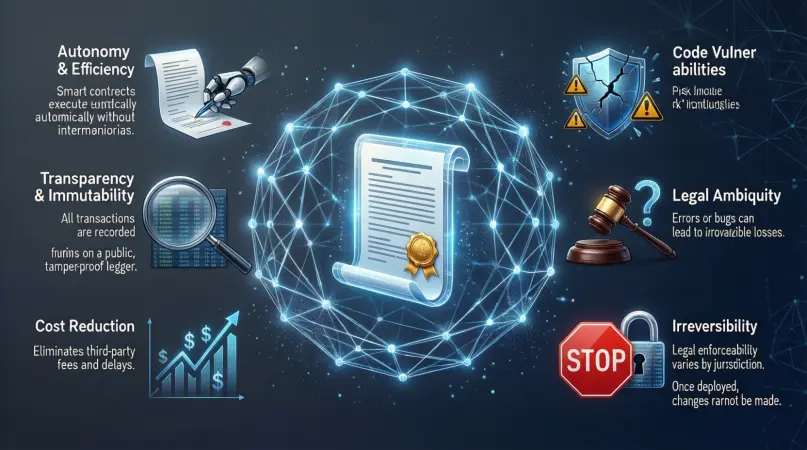
- Efficiency: Automatic execution eliminates manual processes.
- Cost Savings: No intermediaries mean reduced legal and administrative costs.
- Transparency: Participants can view the contract on blockchain.
- Security: Strong encryption reduces fraud and hacking risks.
- Accuracy: Rules are executed exactly as coded, reducing errors.
- Speed: Transactions are faster compared to traditional contracts.
- Global Access: Anyone with a blockchain wallet can interact with contracts.
- Trust: Immutable contracts build confidence between parties.
Disadvantages / Risks
Despite advantages, smart contracts have some risks:
- Coding Errors: Bugs in code can lead to unintended consequences or loss of funds.
- Irreversible Actions: Once deployed, contracts cannot be changed easily.
- Limited Legal Recognition: Some jurisdictions do not fully recognize smart contracts.
- High Gas Fees: Executing contracts on certain blockchains like Ethereum can be costly.
- Complexity: Writing correct smart contract code requires technical expertise.
- Security Vulnerabilities: Poorly written contracts can be exploited by hackers.
Common Mistakes to Avoid
Avoid these common mistakes when using smart contracts:
- Skipping Testing: Always test on testnets before mainnet deployment.
- Ignoring Security: Conduct audits to detect vulnerabilities.
- Overcomplicating Code: Keep contracts simple and clear.
- Neglecting Gas Costs: Calculate transaction fees to avoid unexpected costs.
- Assuming Legal Equivalence: Check local laws for contract enforceability.
- Using Untrusted Platforms: Stick to reputable blockchain networks.
FAQs
1. Are smart contracts legally binding?
Smart contracts can be legally recognized, but it depends on the jurisdiction. While blockchain ensures execution, traditional legal frameworks may still require written agreements for disputes.
2. Can smart contracts be hacked?
Yes, if there are coding vulnerabilities or logic flaws, hackers can exploit contracts. That’s why auditing and secure coding practices are crucial.
3. Do I need programming skills to use smart contracts?
Basic interaction with smart contracts can be done via blockchain wallets. However, creating or modifying contracts requires coding skills in languages like Solidity or Rust.
4. How much does it cost to deploy a smart contract?
Cost varies by blockchain. Ethereum, for example, uses gas fees that fluctuate with network demand. Some blockchains like Binance Smart Chain are cheaper.
5. Can smart contracts be changed after deployment?
No, once deployed, contracts are immutable. Any change requires deploying a new contract. Therefore, testing before deployment is essential.
6. What are common uses of smart contracts?
- Automated payments and payroll
- Supply chain management
- Insurance claims processing
- Real estate agreements
- Decentralized finance (DeFi) applications
7. How do smart contracts improve trust?
Since contracts are stored on a blockchain, all actions are transparent and immutable. This eliminates disputes and builds trust among participants.
Expert Tips & Bonus Points
- Start Simple: Beginners should create simple contracts before attempting complex ones.
- Use Testnets: Always test your code to prevent errors and loss.
- Audit Code: Use third-party audits for critical contracts handling large funds.
- Optimize Gas Usage: Efficient code reduces transaction fees.
- Stay Updated: Blockchain platforms frequently update; ensure compatibility.
- Legal Consultation: Consult legal experts when using smart contracts for official agreements.
- Backup Keys: Always secure private keys used for interacting with contracts.
- Community Support: Engage with developer communities for guidance and best practices.
Conclusion
Smart contracts are transforming the way agreements are made and executed in the digital age. By removing intermediaries, increasing transparency, and automating processes, they save time, reduce costs, and enhance trust. From finance to real estate, supply chains to gaming, smart contracts are finding practical applications in almost every industry.
However, they are not without risks. Coding errors, high fees, and limited legal recognition are factors that users must consider. Testing, audits, and expert guidance can mitigate these risks effectively.