
Introduction
Machine Learning has become one of the most talked-about topics in technology today. From voice assistants like Siri to recommendation systems on Netflix, machine learning powers many tools we use daily. But what exactly is machine learning, and why is it so crucial in modern technology? If you’re new to this field, it might sound complicated at first, but breaking it down into simple steps makes it much easier to understand.
At its core, machine learning is about teaching computers to learn from data without being explicitly programmed for every task. Unlike traditional programming, where every rule is coded manually, machine learning allows systems to improve automatically as they are exposed to more data. This makes it ideal for tasks that are too complex or time-consuming for humans to code manually.
What is Machine Learning?
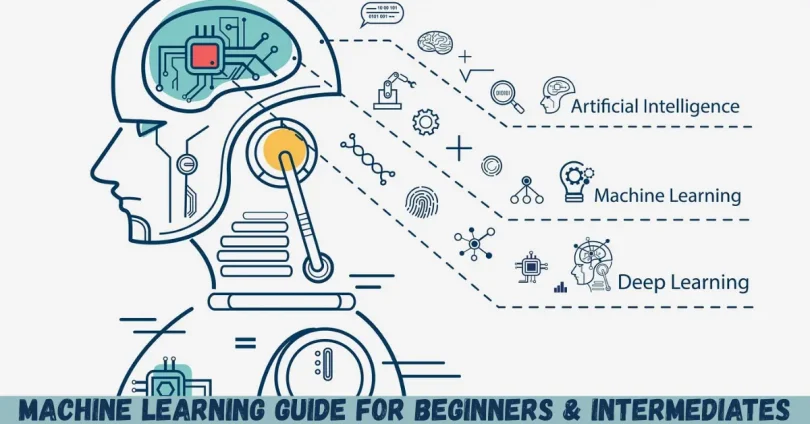
Machine learning is a subset of artificial intelligence that focuses on building systems capable of learning and improving from experience. Instead of following fixed instructions, machine learning algorithms detect patterns in data and make predictions or decisions based on them.
There are three main types of machine learning:
- Supervised Learning – The model is trained using labeled data. For example, predicting house prices based on features like size, location, and age.
- Unsupervised Learning – The model works with unlabeled data to find hidden patterns, such as grouping customers based on purchasing behavior.
- Reinforcement Learning – The model learns by trial and error, receiving feedback from its actions. It is commonly used in robotics and game AI.
Machine learning also includes other approaches, such as semi-supervised learning, deep learning, and natural language processing. Each has unique applications depending on the type of data and the problem being solved.
In essence, machine learning allows computers to mimic human learning by analyzing large amounts of data and recognizing trends, ultimately enabling smarter decisions and automation.
Why is Machine Learning Important?

Machine learning has transformed industries by automating tasks, improving accuracy, and uncovering insights that were previously difficult to detect. Its importance lies in several key areas:
- Data-Driven Decision Making: Businesses can use machine learning to analyze large datasets and make informed decisions quickly.
- Automation: Repetitive tasks, such as fraud detection or email filtering, can be automated, saving time and resources.
- Personalization: Online platforms like e-commerce sites and streaming services use machine learning to provide personalized recommendations.
- Predictive Analysis: Companies can forecast sales, customer behavior, and market trends more accurately.
- Healthcare Innovation: Machine learning aids in disease detection, drug development, and patient care optimization.
Overall, machine learning enhances efficiency, reduces human error, and enables businesses and individuals to extract meaningful insights from massive datasets.
Detailed Step-by-Step Guide to Machine Learning
Implementing machine learning can seem complex, but breaking it into clear steps makes it manageable.
Step 1: Define the Problem
Start by clearly defining what you want the machine learning model to achieve. For example:
- Predicting customer churn
- Recognizing handwritten digits
- Forecasting stock prices
A clear problem statement ensures the right data and model selection.
Step 2: Collect and Prepare Data
Data is the foundation of machine learning. Collect quality data relevant to your problem. Then, clean it by:
- Removing duplicates and missing values
- Handling outliers
- Normalizing or scaling features
For instance, if you are predicting house prices, ensure your dataset includes consistent data on size, location, and price.
Step 3: Choose a Machine Learning Algorithm
The algorithm depends on the type of problem:
- Regression: Predicting continuous values (e.g., house prices)
- Classification: Categorizing data (e.g., spam vs. non-spam emails)
- Clustering: Grouping similar data (e.g., customer segments)
- Reinforcement Learning: For decision-making tasks with feedback
Popular algorithms include Linear Regression, Decision Trees, Random Forest, Support Vector Machines, and Neural Networks.
Step 4: Split the Dataset
Divide your data into training and testing sets:
- Training Set: Used to train the model
- Testing Set: Used to evaluate the model’s performance
A common split is 80% training and 20% testing.
Step 5: Train the Model
Feed the training data into the chosen algorithm. The model will learn patterns and relationships in the data.
For example, a model predicting sales will learn how features like price, season, and promotion influence revenue.
Step 6: Evaluate the Model
After training, assess the model using the testing data. Key metrics include:
- Accuracy: Percentage of correct predictions
- Precision and Recall: For classification problems
- Mean Squared Error (MSE): For regression problems
If performance is poor, revisit steps like feature selection or algorithm choice.
Step 7: Fine-Tune and Optimize
Improve model performance by:
- Adjusting hyperparameters
- Using feature engineering
- Trying different algorithms
- Using ensemble methods
Step 8: Deploy and Monitor
Once satisfied, deploy the model for real-world use. Continuously monitor performance, as data may evolve over time, requiring updates.
Benefits of Machine Learning
Machine learning offers numerous advantages for businesses and individuals:
- Automates repetitive tasks
- Improves accuracy in predictions
- Enhances decision-making with data insights
- Provides personalized user experiences
- Detects anomalies and fraud efficiently
- Speeds up processes in healthcare, finance, and logistics
- Enables scalable solutions without extensive manual intervention
Disadvantages / Risks
While machine learning is powerful, it has some drawbacks:
- Requires large datasets for accuracy
- Sensitive to biased or poor-quality data
- Can be computationally expensive
- Lack of transparency in complex models (black-box problem)
- Risk of overfitting or underfitting
- Ethical concerns in automated decision-making
Common Mistakes to Avoid
Avoid these mistakes to ensure successful machine learning projects:
- Ignoring Data Quality: Poor data leads to inaccurate models.
- Overfitting: Model performs well on training data but poorly on new data.
- Choosing the Wrong Algorithm: Not all algorithms suit every problem.
- Neglecting Feature Engineering: Features significantly impact model accuracy.
- Skipping Model Evaluation: Without testing, you can’t know if the model works.
- Ignoring Updates: Models must be updated as new data comes in.
FAQs
1. What is the difference between AI and machine learning?
AI is a broad field aiming to create intelligent systems. Machine learning is a subset that focuses on systems learning from data.
2. Do I need to be a programmer to learn machine learning?
Basic programming knowledge, especially in Python, is helpful but not mandatory. Tools and platforms simplify many tasks for beginners.
3. What are real-world examples of machine learning?
Spam filters, product recommendations, voice assistants, fraud detection, and self-driving cars are common examples.
4. How long does it take to learn machine learning?
Learning the basics may take a few weeks, while mastering it can take months or years, depending on your dedication and practice.
5. Can machine learning replace humans?
It automates repetitive tasks and improves efficiency but cannot fully replace human creativity, judgment, or empathy.
6. What skills are essential for machine learning?
Key skills include programming (Python/R), statistics, data analysis, linear algebra, and problem-solving.
7. Is machine learning expensive to implement?
It can be, depending on data size, computational resources, and complexity. Cloud services make it more affordable for beginners.
8. What is the future of machine learning?
The future includes smarter AI systems, better predictive analytics, improved personalization, and more automation across industries.
Expert Tips & Bonus Points
- Start Small: Begin with simple datasets before moving to complex projects.
- Practice Regularly: Hands-on practice improves understanding faster than theory alone.
- Learn Python Libraries: Focus on scikit-learn, TensorFlow, and PyTorch.
- Understand Data: Quality and preparation of data are as important as algorithms.
- Experiment Often: Testing multiple models and parameters helps discover the best approach.
- Stay Updated: Machine learning evolves rapidly, so follow the latest trends and research.
- Document Your Work: Clear notes make it easier to replicate and improve projects.
Conclusion
Machine learning is a transformative technology shaping the future of multiple industries. It allows systems to learn from data, make predictions, and automate complex processes, offering efficiency, accuracy, and valuable insights. While learning it may seem challenging initially, a step-by-step approach and consistent practice make it achievable for beginners and intermediate learners alike.
Understanding the fundamentals, from defining problems and preparing data to deploying models and monitoring performance, is key to success. Awareness of common mistakes and potential risks ensures smoother implementation.